



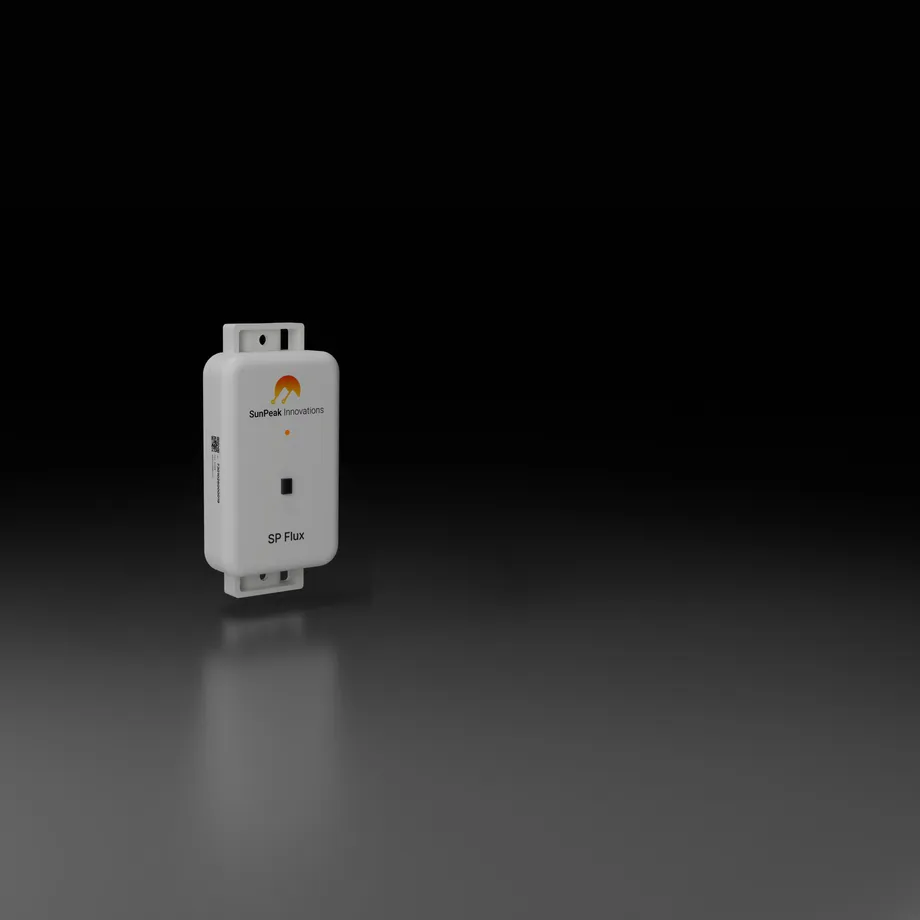
SP Flux
Wireless thermal
imaging logger
A LoRaWAN thermal imager on a battery. SP Flux watches a whole scene as an 8×8 field of 64 temperatures, spots a single hot pixel against the learned background and sends the alarm at once — with the hottest point and a full thermal picture in SmartCloud.
Key features
 8×8 thermal array: 64 temperatures, 60° field of view
- Hot-spot detection per pixel against the background
- Alarm at once, full thermal picture in the cloud
- Finds its network itself: SP Net gateway or LoRaWAN
- Archive in memory, nothing lost when the link drops
- Set-up by phone over NFC and over the air
64 temperatures in a single glance
 Worldwide Helium Network compatibility
 Ready to work out of the box
 3 years warranty period
Use Cases
Electrical cabinets and equipmentOne SP Flux watches a whole cabinet or machine: a loose terminal or an overloaded bearing heats a few pixels while the rest stays cool. The sensor compares every pixel with the learned background, so a warm room does not raise an alarm, and a local hot spot of +1 °C and more does.
Warehouses and fire preventionMounted under the ceiling over a storage zone, SP Flux sees heat build up in goods, batteries or chargers long before smoke appears, and reports the place in the 8×8 picture.
Greenhouses and apiariesThe full thermal picture shows how heat is spread over beds or inside a hive cover; SmartCloud keeps the history of every pixel and draws it as a heat map.
People and presencePeople are warmer than the background: SP Flux shows where they stand and how many warm spots there are — without images of faces, privacy-safe.
Technical specifications
The warranty period is 3 years from the production date.
| Sensor | Thermopile array 8×8 = 64 pixels (Panasonic Grid-EYE AMG8833), 60°×60° field of view |
|---|---|
| Temperature range | 0…+80 °C (object surface) |
| Accuracy | ±2.5 °C absolute (sensor datasheet); resolution 0.25 °C |
| Hot-spot detection | Pixel above the learned background by 1 °C (default, configurable), confirmed by a second probe; optional absolute threshold |
| Reporting | Alarm and clear at once; summary (hottest point, median, hot pixel) every hour; full 8×8 picture every 6 h and on change; all configurable |
| Data memory | Archive in flash with delivery confirmation: about 4 months of a quiet scene |
| Radio standard | LoRaWAN 1.0.4 Class A (OTAA/ABP), EU868, or SP Net single-channel (two-way); automatic network selection |
| Communication range | up to 5 km (line-of-sight) |
| Configuration | NFC (SunPeak Devices app, Android/iOS); over the air via SP Net and LoRaWAN networks, signed |
| Power source | 3.6 V 2400 mAh ER14505 Li-SOCl₂ |
| Battery life | up to 5 years (depends on the probing and reporting profile) |
| Operating temperature | 0…+80 °C (sensor limits), indoors |
| Dimensions | about 100 × 50 × 22 mm |
SmartCloud Ecosystem
Cloud ReadyPlug & Play: register the device and point it at the scene — the sensor learns the background itself, no calibration on site.
Heat mapEvery snapshot is shown as a smooth heat map with the hottest and coolest points marked; the same map can be put on an SP Screen e-ink board next to the equipment.
Overheating alarmsSmartCloud turns the sensor alarms into events with time, place in the picture and peak temperature, and notifies the right people by Telegram or SMS.
History and trendsCompare the scene week by week, see slow heating of a connection or a bearing long before it fails.
SP Flux — documents and ordering
 Datasheet
SP Flux — frequently asked questions
What does SP Flux measure?
The surface temperature of everything in its 60° field of view as an 8×8 grid of 64 values, 0…+80 °C with 0.25 °C resolution. It is a thermal imager, not a thermometer of one point: the value of SP Flux is the picture and the change of single pixels.
How does it detect a hot spot?
The sensor learns the usual picture of the scene and compares every pixel with it, after subtracting the common change of the whole scene. A pixel that is warmer than its background by the threshold (1 °C by default) on two probes in a row raises an alarm; a warm room or a sunny day does not.
How fast does an alarm reach the cloud?
Within the probe interval plus one minute of confirmation — about 3…4 minutes at default settings. The alarm frame carries the hottest point and its place; the full picture follows in the next frames.
How far can it see?
The field of view is 60°: from 3 m it covers about a 3.5 × 3.5 m area, one pixel is about 45 cm. A small hot object is seen as a warmer pixel; the closer the sensor, the smaller the object it resolves.
How long does the battery last?
Up to 5 years with default settings. The main factor is the probe interval: frequent probing catches fast heating sooner but uses more energy. SmartCloud shows the battery forecast for every device.
Which network does SP Flux use?
It chooses by itself: LoRaWAN (for example Helium) or an SP Net gateway on site, and switches if the link is lost. Data is kept in the device memory until the cloud confirms delivery.
Does SP Flux see through glass?
No. Infrared does not pass through glass or plastic windows; the sensor must look at the object directly. Shiny metal reflects the surroundings — for exact values put a matt label on it.
What is the part number?
SP Flux (wireless thermal imaging logger) is ordered from SunPeak Innovations under part number SP730.